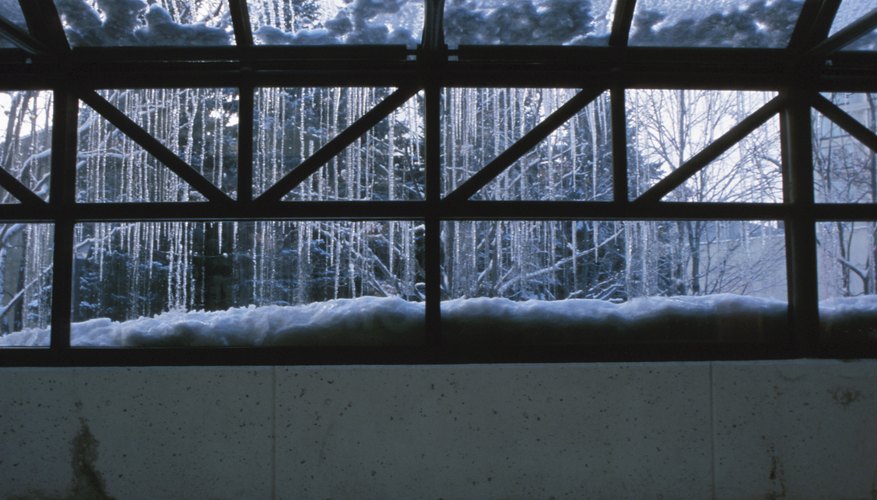
A lean-to greenhouse is half of a greenhouse that is built against an existing building, such as your house, barn or shed. Lean-to greenhouses are useful for gardeners who want a greenhouse, but have limited space or resources for building one. Factors involved in building lean-to greenhouses are available space and the amount of sunlight that space receives throughout the year. Building a lean-to greenhouse takes time, effort and preparation, but the end result will allow you to garden more effectively throughout the year.
Decide where on your house or building you want the lean-to greenhouse to be constructed. Place the greenhouse near a door and an electrical socket if possible. Ensure that the location of your lean-to greenhouse gets at least four to six hours of direct sunlight each day, even in winter.
- A lean-to greenhouse is half of a greenhouse that is built against an existing building, such as your house, barn or shed.
- Decide where on your house or building you want the lean-to greenhouse to be constructed.
Measure the foundation for your lean-to greenhouse with a tape measure. Mark the corners with stakes.
Dig 20 cm (8 inch) deep trenches for three pieces of 20 cm (8 inch) thick by 20 cm (8 inch) wide timber for the foundation of your greenhouse. Each piece of timber should be as long as one sides of your greenhouse.
Frame your walls with 5 x 5 cm (2 x 2 inch) timber.
Use a screwdriver to attach a 5 x 5 cm (2 x 2 inch) board the width of your greenhouse to the side of the building you are putting the greenhouse on. This board should be 2.4 to 3 m (8 to 10 feet) off of the ground. Frame the back wall around this board.
- Measure the foundation for your lean-to greenhouse with a tape measure.
- Use a screwdriver to attach a 5 x 5 cm (2 x 2 inch) board the width of your greenhouse to the side of the building you are putting the greenhouse on.
Frame the front wall so that it is 1.8 to 2.4 m (6 to 8 feet) tall to allow water to run off of the roof of your lean-to greenhouse.
Add boards to the side and top of your frames to create a support structure for your greenhouse. Each vertical board will need to be angled to fit the slant from the back wall to the front wall of your lean-to greenhouse.
- Frame the front wall so that it is 1.8 to 2.4 m (6 to 8 feet) tall to allow water to run off of the roof of your lean-to greenhouse.
- Add boards to the side and top of your frames to create a support structure for your greenhouse.
Cut wire mesh to fit the roof of your greenhouse structure and use a staple gun to attach it to support the greenhouse cover.
Attach polythene panels or plastic sheeting to the top and sides of your greenhouse with nails or staples. Overlap the seams of your greenhouse cover to seal it tightly. Leave space on the front or side for a greenhouse zip door or wooden door.
Attach the greenhouse zipper door or wooden door according to the directions on the door.
Put plants inside your lean-to greenhouse. Water plants regularly.
TIP
Wear safety goggles and gloves, as well as long sleeves and trousers, during the building process to avoid injury.