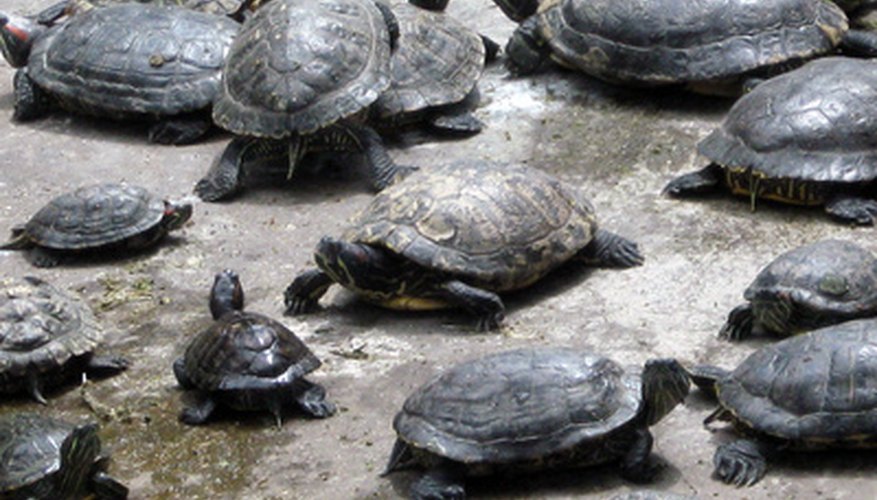
Red-eared sliders are pond turtles and among a diverse subspecies collection of pond sliders. They are nicknamed the "dime-store turtle" because of their popularity in the pet trade. In the United States, their native range is from Illinois to West Virginia and in most of the South, although the pet trade has allowed them to invade most of the country. Dead red-eared sliders can pose the potential threat of E. coli and salmonella, so they require careful handling.
Put on rubber gloves, especially if you are in a place where you cannot wash your hands. Red-eared sliders are aquatic, and being such they may have algae or other plant material on their shells. Max Nickerson, Ph.D., a professor and curator at the University of Florida, says that E. coli "is often concentrated in this and other plant material" and that E. coli can be resistant to the temperature on land.
- Red-eared sliders are pond turtles and among a diverse subspecies collection of pond sliders.
- Red-eared sliders are aquatic, and being such they may have algae or other plant material on their shells.
Ensure the red-eared slider is actually dead. Examine its eyes. A dead turtle's eyes sink into its head. Notice any smell coming from the animal and if it indeed smells like rotting flesh. Pull the turtle's legs out and extend them. Then look near the turtle's "armpit" to see if it is breathing. Identifying a dead turtle is not as simple as identifying death in other animals. A turtle's heart can beat long after death, sometimes even after it's removed from the body.
- Ensure the red-eared slider is actually dead.
- A turtle's heart can beat long after death, sometimes even after it's removed from the body.
Take the turtle to a veterinarian who treats turtles if the turtle you think is dead is a pet. The veterinarian can help you determine in certainty that it is in fact dead, allowing you to avoid the costly mistake of disposing of a pet that is mimicking death.
Bury your pet turtle if it is indeed dead.
Consult any state laws regarding the removal of dead turtles if the dead slider is not a pet and in the wild, particularly on state-owned or federally owned lands. Laws can change rapidly regarding removal of these turtles. If on government-owned lands, consult a ranger or other official for the area.