Although many venomous spiders live in the United Kingdom, there have been very few recorded spider bites and, according to the Natural History Museum of London, no recorded deaths.
Although spiders native to the UK are not generally considered life-threatening hazards, their bites can range from mildly irritating nips to severely painful ones that may hurt for days. In addition, dangerous exotic spiders imported from other countries occasionally show up in UK homes.
Bark Sac Spider (Clubiona Corticalis)
Bark sac spiders can grow to about 10mm, and feature brown colouring and the dark line along their abdomens that becomes a pattern of chevrons.
- Bark sac spiders can grow to about 10mm, and feature brown colouring and the dark line along their abdomens that becomes a pattern of chevrons.
Generally, they inhabit old trees and buildings, but do live in houses, where they will walk along the walls.
Look for them from April to September. A bite often can cause localised pain and blistering.
Black Lace Weaver Spider (Amaurobius Ferox)
Black lace weaver spiders range from dark brown to black. Females can reach lengths of up to 16mm, while males tend to be about 14mm. Their abdomens bear indistinct pale yellowish markings.
These spiders build lacelike webs around funnels, and are found in forests, gardens and cellars all year long.
- Black lace weaver spiders range from dark brown to black.
- These spiders build lacelike webs around funnels, and are found in forests, gardens and cellars all year long.
Bites can cause localised pain and swelling. Nausea is a possibility, too.
Bruennichi's Argiope (Argiope Bruennichi)
These brightly coloured spiders sport yellow and black bands on their abdomens and females can reach sizes of up to 24mm, while males tend to stay around 10mm.
Their webs are distinct vertical orbs, often with a central zigzag pattern.
- These brightly coloured spiders sport yellow and black bands on their abdomens and females can reach sizes of up to 24mm, while males tend to stay around 10mm.
- Their webs are distinct vertical orbs, often with a central zigzag pattern.
Argiope tend to stay outside in gardens, and are present from June to September. They can wander into homes, though.
Cellar Spider (Steatoda Grossa)
Also called "false widow" spiders because of their resemblance to the black widow, these spiders are black or even somewhat purple. The females are 10mm.
- Also called "false widow" spiders because of their resemblance to the black widow, these spiders are black or even somewhat purple.
The males, at 6mm, are not as likely to bite as their female counterparts.
Females have a pale crescent moon shape, followed by three small dots on their abdomens. They will build tangled webs with sticky white spheres in dark corners and outbuildings all year long.
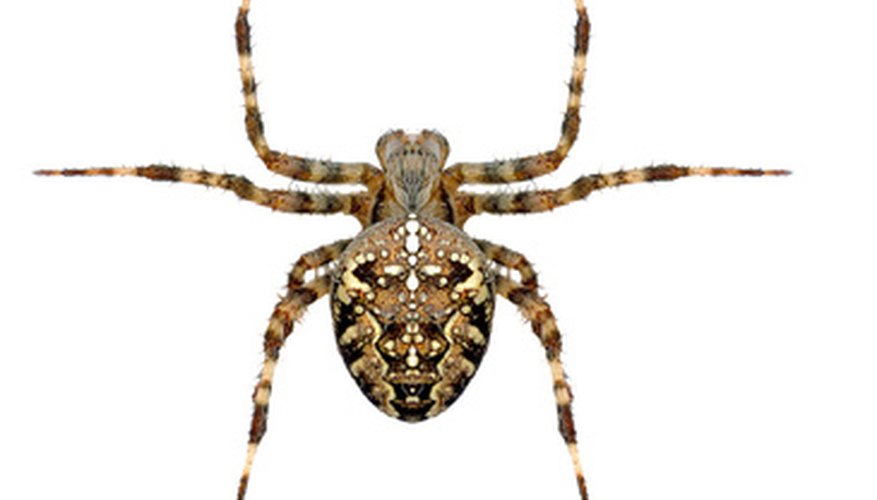
Cross/Garden Spider (Araneus Diadematus)
You can identify cross or garden spiders by their mottled brown, beige, brick red and black colouring overlaid by a cross of pale spots on the abdomen. Their legs are distinctively spiny.
Females grow to 18mm, and are much more likely to bite than the smaller males that grow to half the size.
They spin vertical orb webs from June to November,and tend to stay outside in the gardens and woodland, although they make seek shelter in homes during autumn. A bite can cause pain, nausea and swelling.
- You can identify cross or garden spiders by their mottled brown, beige, brick red and black colouring overlaid by a cross of pale spots on the abdomen.
- They spin vertical orb webs from June to November,and tend to stay outside in the gardens and woodland, although they make seek shelter in homes during autumn.
False Widow Spider (Steatoda Nobilis)
These spiders are round and brown and inhabit buildings and fences.
- These spiders are round and brown and inhabit buildings and fences.
Only the females, which grow to about 15mm, can bite. They originally came from the Canary Islands and Madeira, but have spread throughout south and east England. A bite can cause local pain that spreads and leads to numbness and swelling.
Lace Weaver Spider (Amaurobius Similis)
Lace weaver spiders are dark, ranging from brown to black, with fuzzy abdomens. The markings on the abdomen are dark and wedge-shaped, surrounded by a cream colour. Females grow up to 10mm while the males only reach about 7mm.
These spiders are found on walls, around windows or under old pots all year long. They spin lacy webs around holes and crevices.
- Lace weaver spiders are dark, ranging from brown to black, with fuzzy abdomens.
- These spiders are found on walls, around windows or under old pots all year long.
Mouse Spider (Herpyllus Blackwalli)
Named for their mousy colouring (grey to grey-brown) and furry abdomens, mouse spiders can reach sizes of about 12mm for females and 10mm for males.
These spiders have low, flat builds, and are nocturnal hunters along walls all year long. A bite victim reported a painful pimple-like wound that burst after a few days resulting in infection of the entire hand.
Rustic Wolf Spider (Trochosa Ruricola)
The rustic wolf spider is dark brown with a pale band running nearly the length of the body. The females grow to about 15mm, while the males only reach 10mm.
They live in scrub, woodland, lawns and gardens from April to June and don't spin webs. Bites cause localised pain and redness.
- The rustic wolf spider is dark brown with a pale band running nearly the length of the body.
- Bites cause localised pain and redness.
Stone Spider (Drassodes Lapidosus)
These distinctive spiders are brown with a long pale abdomen and large, dark jaws. Two of its eyes will appear silvery. They tend to spend the day hidden in a web sac beneath stones and loose bark before emerging during the night to hunt all year long. Females can be 18mm, while males only reach about 12mm.
- These distinctive spiders are brown with a long pale abdomen and large, dark jaws.
- They tend to spend the day hidden in a web sac beneath stones and loose bark before emerging during the night to hunt all year long.
Tube Web Spider (Segestria Florentina)
Female tube web spiders can be 22mm, while the males reach 15mm.
Black or dark brown, these cigar-shaped spiders inhabit walls, fences and tree bark from June to November.
Their webs are tube-shaped and set in holes or crevices with trip lines running out. Victims report sharp and painful bites that result in soreness and swelling.
- Female tube web spiders can be 22mm, while the males reach 15mm.
- Their webs are tube-shaped and set in holes or crevices with trip lines running out.
Imported Exotic Spiders
Occasionally, spiders not native to the UK may make their way into your home via imported goods. Reported venomous invaders include the exotic sac (Cheiracanthium), the huntsman (Heteropoda venatoria), the false widow (Steatoda paykulliana) and the black widow (Latrodectus mactans).
The bites of all but the black widow spider are generally painful, but not life-threatening. The black widow bite can produce an array of serious symptoms, though people rarely die from a bite, according to eMedicineHealth.
- Occasionally, spiders not native to the UK may make their way into your home via imported goods.
- The black widow bite can produce an array of serious symptoms, though people rarely die from a bite, according to eMedicineHealth.